Air France Airbus A330-203 plane crash
Atlantic ocean
Updated on
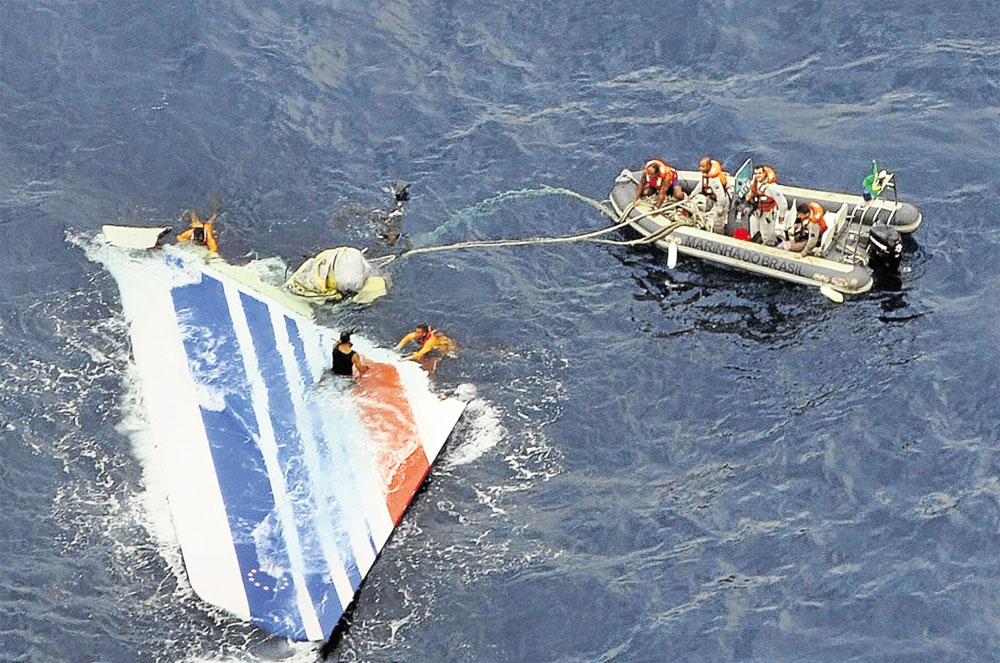
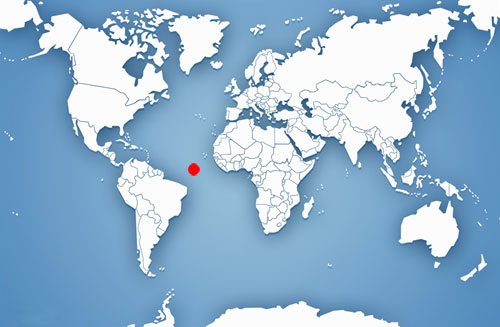 The Air France Airbus A330-200 went missing on transatlantic flight from Rio de Janeiro, Brazil, to Paris, France. The airplane carried 12 crew members and 216 passengers. The plane crashed in the Atlantic Ocean, killing all onboard.
Flight AF447 departed Rio de Janeiro heading toward Paris. Three hours later, while the plane was flying over the Atlantic Ocean, the aircraft reportedly went through a thunderstorm with strong turbulence. A few minutes later, Air France received an automatic message from the A330 indicating electrical circuits malfunction. It was the last information received from AF447. Six minutes later, Brazilian Air Force said plane failed to make previously scheduled radio contact with Brazil.
Last radio contact with the flight was at 01:33 UTC. The crew was in contact with the Atlantic Area Control Centre (CINDACTA III) when the flight reported over the INTOL waypoint, estimating TASIL at 02:20 UTC. INTOL is an RNAV waypoint located in the Atlantic Ocean, 565 km from Natal, Brazil. The TASIL waypoint is located 1228 kilometers from Natal.
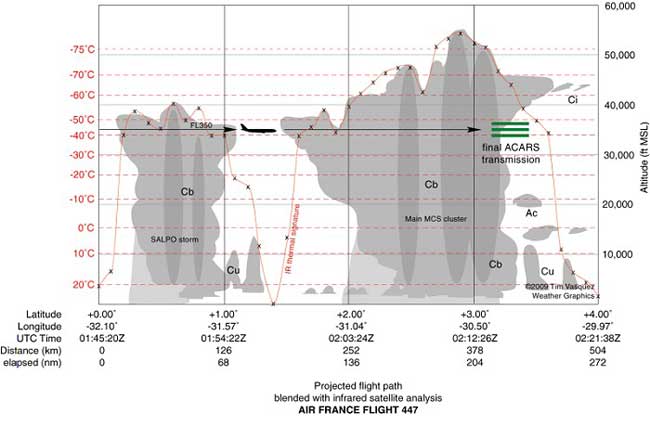
Over a time span of four minutes, starting at 02:10 UTC, a series of ACARS messages were sent -automatically- from the plane. Indication was that the
autopilot had disengaged and the fly by wire system had changed to alternate law (mode allowing the flight control to work properly while some inputs paramters are not available or detected erroneous). Between 02:11Z and 02:13Z a flurry of messages indicating failure of navigation and air data systems arrived. At 02:13Z flight control system faults were indicated, at 02:14Z the last message received was an advisory regarding cabin vertical speed.
An analysis of meteorological information shows that AF447 crossed through three key thunderstorm clusters: a small one around 01:51 UTC, a new rapidly growing one at about 01:59 UTC, and finally a large multicell convective system (MCS) around 02:05-02:16 UTC.
Also, investigators said the aircraft's maintenance complied with requirements, there were no reports of technical problems from the crew, and there was no distress call - either to air traffic control or other aircraft - at the time of the loss on 1 June.
Analysis of the DFDR parameters and of the storm the aircraft crossed through shows that:
- Strong turbulence could have occured around the periphery of the storm
- Recent evidence from spaceborne sensors is pointing to the possibility that this system contained no lightning
- Although it is possible the plane flew through exceptionally high values of precipitable water content, it is more likely that the plane have been mostly in an area of ice crystals with possibly some graupel at flight level.
- The plane flying at FL350 (around 10,000 m), was experiencing flight level temperatures of around -44 deg C (ISA + 11 deg C). During a briefing with the captain of both flight officers, it was mentioned that the plane could not climb above FL 350 as the temperature is highter than expected, so the REC MAX is a little to low.
- The plane flying at FL350 would have been far above the level where big hail particles would grow.
- A few minutes before the accident, the crew made a heading change of 12° t o the left of its route, probably after having analysing the weather radar data.
On May 1st 2011, the investigation team localized and identified the memory unit from the Digital Flight Data Recorder (DFDR). It was raised and lifted on board the ship Ile de Sein by the Remora 6000 ROV.
On May 2nd 2011, the investigation team localized and identified the Cockpit Voice Recorder (CVR). It was raised and lifted on board the Ile de Sein by the Remora 6000 ROV on 3rd May, 2011.
On May 27th 2011, the BEA (French investigation board) issued a very short and synthetic note detailing the circumstances of the accident.
On July 29th 2011, the BEA issued an intermediate report detailing the circumstances of the accident.
The BEA analysis shows that once the aircraft entered the turbulence area, the autopilot then auto-thrust disengaged. The airplane began to roll to the right and the PF (Pilot in Function) made a left nose-up input.
The stall warning sounded twice in a row, and the indicated speed shows a sharp fall from about 275 kts to 60 kts (this fall is similar to what happens in case of Pitot obstruction, such as icing). Vibrations probably due to buffet appeared. At the same time, the airplane’s pitch attitude increased progressively beyond 10 degrees and the plane started to climb. The PF corrected slightly the trajectory. A few seconds later, the stall warning was triggered again. The thrust levers were positioned in the TO/GA detent and the PF maintained nose-up inputs.
Around fifteen seconds later, the indicated speed increased sharply towards a credible value (185 kts). Less than one minute later, the captain, who left the two flight officers in command about 10 minutes earlier, came back in the flight deck.
A few seconds later, all of the recorded speeds became invalid or inconsistent. These parameters are recovered a few seconds later, and then changed sporadically between « valid and consistent » and « invalid or inconsistent ». Airspeed is sometimes displayed to the crew, sometimes not displayed (when not displayed, a flag is displayed instead). In the two last minutes of the flight, the airspeed not displayed to the crew during most of the time. The stall warning triggered sporadically, depending on whether the angle of attach measured is higher than a threshold or not, and depending on whether the parameters used in the warning algorithm are valid or not (for example, the stall warning is inhibited if the airspeed is invalid).
The plane stalled and the vertical speed was about -10,000 ft/min. The PF made an input on the sidestick to the left and nose-up stops, which lasted about 30 seconds. However, none of the crewmember have formally detected they were stalling, and none of them mentioned the word “stall” during their conversation. Simultaneous inputs by both pilots on the sidesticks were recorded – These inputs were sometimes antagonist. The crew noticed the plane was descending, but did not succeed in recovering the plane during the 2 minutes and 48 seconds fall.
The plane impacted ocean violently. The last recorded values were a vertical speed of -10,912 ft/min (a bit less than 200 km/h), a ground speed of 107 kt (a bit less than 200 km/h), pitch attitude of 16.2 degrees nose-up, roll angle of 5.3 degrees left and a magnetic heading of 270 degrees.
This accident is the 8th worst plane crash since year 2000 in terms of the number of combined onboard and ground fatalities. Watch here the list of the worst aircraft crashes since year 2000.