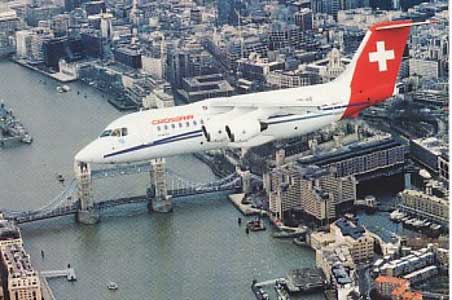
Crossair BAe 146-300 plane crash
Key facts
- Airline
- Crossair
- Aircraft
- BAe 146-300
- Location
- Zurich, Switzerland
- Date
- 24th November, 2001
- People on board
- 33
- Fatalities
- 24
Updated on
Accident account
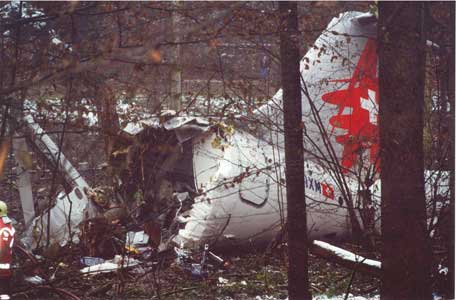
On the night of November 24th 2001, at 20:01 UTC, the Crossair Avro 146-RJ 100 registered HB-IXM, operating scheduled flight CRX 3597 from Berlin to Zurich, took off from runway 26L at Berlin-Tegel Airport. At 20:58:50 UTC, after an uneventful flight, the aircraft was cleared to perform the standard VOR/DME approach to runway 28 at Zurich Airport. The crew of the Embraer EMB 145 operating flight CRX 3891, which was ahead of it in the approach sequence, informed the control tower that the minimum visibility required for the VOR/DME 28 approach had almost been reached.
At 21:05:21 UTC, flight CRX 3597 reported on the tower frequency. At 21:06:10 UTC, as the aircraft reached the minimum descent altitude of 2390 ft QNH, the captain told the first officer that he had more or less established visual contact with the ground and continued the descent. At 21:06:36 UTC, the aircraft struck the tops of trees and then crashed into the ground. The aircraft caught fire on impact. Twenty-one passengers and three crew members were fatally injured at the accident site. Seven passengers and two crew members survived the accident.
The investigation established the following causal factors of the accident:
- The captain deliberately descended below the published minimum descent altitude for the standard VOR/DME 28 approach procedure.
- The first officer did not attempt to prevent the continuation of the flight below the minimum descent altitude.
- The crew had not established visual contact with the approach lighting system or the runway.
- The approach sector for runway 28 at Zurich Airport was not equipped with a minimum safe altitude warning system (MSAW).
- Over a long period, the responsible persons concerned within the company did not adequately assess the captain’s flying performance. Appropriate measures were not taken to address the shortcomings identified.
- The captain’s ability to concentrate, make decisions and analyse complex processes was reduced by fatigue.
- The allocation of duties in the cockpit during the approach was inadequate and did not comply with the procedures prescribed by the company.
- The terrain struck by the aircraft was not shown on the approach chart used by the crew.
- The meteorological visibility measured at the airport was not representative of the approach to runway 28 because it did not correspond to the actual flight visibility in the approach sector.
- The visibility minima in force at the time of the accident were inappropriate for operation of the standard VOR/DME 28 approach procedure.
Accident location
The aircraft (BAe 146-300)
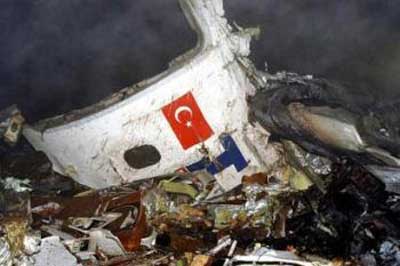
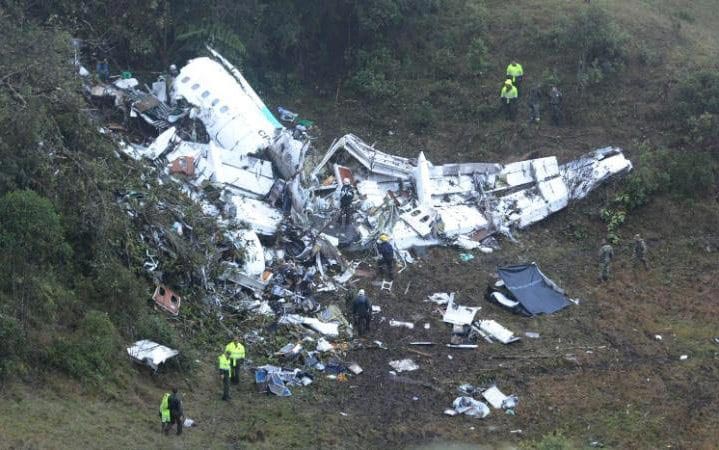
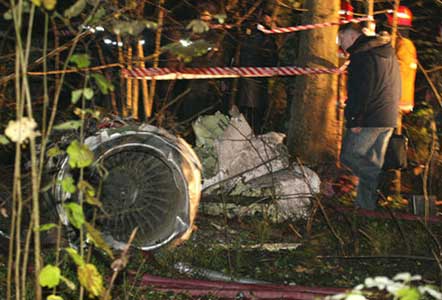
Photos