
Some 583 people died or were mortally injured on March 27th 1977 when two Boeing 747 jumbo jets collided on a runway at Los Rodeos Airport, Tenerife, in the Canary Islands, making it the world's worst civil aviation disaster.
Tenerife in the Canary Islands

The Canary Islands are located in the Atlantic Ocean, off the western coast of Africa, between 27 and 29 degrees north latitude, and between 13 and 18 degrees west longitude. The islands are volcanic. Tenerife lies in the middle of the archipelago and is 81 km long and 45 km wide.

Diversion to Los Rodeos Airport
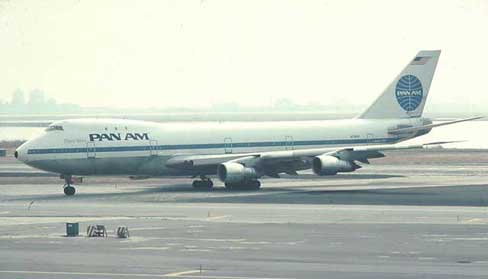
The PanAm Boeing 747-121, on a charter passenger flight from Los Angeles to Las Palmas, had been flying for eight hours. Some 396 people, including 16 crew members, were on board. Its captain was annoyed because he had not obtained clearance to land at Las Palmas. A bomb had exploded there two hours earlier and the airport was closed for repair. The 747 was instructed to divert to Tenerife, 70 km west of Las Palmas. The captain and his passengers were unhappy with this arrangement, but they had no other choice.
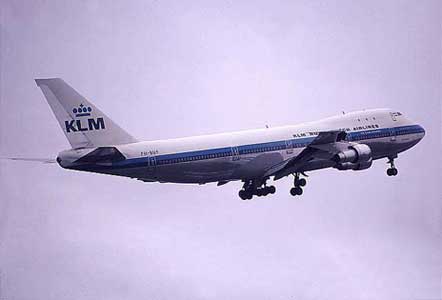
At 14h15 GMT, PanAm flight 1736 was on final approach to runway 30. The landing at Los Rodeos Airport (Tenerife) was smooth, but the captain noticed the unusually large number of aircraft at the airport. Many aircraft, including a 747-206B from KLM, had landed there following the closure of Las Palmas airport. The small Tenerife airport was now saturated.
The PanAm 747 was instructed to park in fourth position, behind the KLM 747. The KLM aircraft was also operating a charter flight (KLM 4805). It had landed 45 minutes previously, with 248 people on board, including 14 crew members. Its captain was nervous: very strict Dutch regulations prevented the crew to exceed their quota of flying hours. If the plane did not take off soon, its captain and KLM could be in serious trouble.
At 14h30 GMT, there was finally some good news: the Tenerife control tower informed all grounded aircraft that Las Palmas airport had just re-opened. The controller informed the PanAm captain that in order to speed up take-off he could taxi right behind the KLM 747. The PanAm captain agreed.
Fog covers the airport
The weather deteriorated: heavy fog would soon cover the airport. Visibility rapidly dropped to a few hundred meters (300 feet). At 16h51, the KLM 747 was cleared to start its engines. At 16h52, the PanAm 747 requested clearance to start its engines. The control tower's answer was as follows:
16:52 (Tenerife control tower) - PanAm 1736, you are cleared to start. Report ready for taxi. For your information, you will have to backtrack behind the other 747 and leave the runway third taxiway to your left.
The two Boeing 747s backtrack the runway
Both 747s would therefore backtrack the length of the 3,400-meter (11,000 feet) runway at low speed. The KLM aircraft would backtrack to the end of the runway, make a U-turn and report ready for take-off. The PanAm plane would leave the runway via the third taxiway in order to free the way for the KLM aircraft to take off. Given the heavy traffic at the airport, this was deemed the simplest solution.
At 16h55, the Dutch 747 reached the runway, the American 747 a few hundred meters behind it. The fog was growing denser: the 747s could not see each other, and neither aircraft could be seen from the control tower. The visibility was less than 200 meters.
17 :01 :57 (PanAm first officer) – Tenerife the Clipper one seven three six.
17 :02 :01 (Tenerife control tower) – Clipper one seven three six Tenerife.
17 :02 :03 (PanAm first officer) – Ah. We were instructed to contact you and also to taxi down the runway, is that correct?
17 :02 :08 (Tenerife control tower) – Affirmative, taxi into the runway and -ah leave the runway third, third to your left.
17 :02 :16 (PanAm first officer) – Third to the left, OK.
Background conversations in the control tower made the instructions difficult for the crew to hear.