1001 Crash — Lessons learnt for safer aviation Return to the 1001 Crash home page

20 worst airplane disasters since 2000

List of the 20 worst airplane disasters and accidents since 2000, in terms of combined onboard and ground fatalities :

American Airlines Airbus A300B4 crash
Airline : American Airlines
Aircraft : Airbus A300B4-605R
On November 12, 2001, about 09:16:15 eastern standard time, American Airlines flight 587, an A300-605R, N14053, crashed into a residential area of Belle Harbor, New York, shortly after takeoff from John F. Kennedy International Airport, Jamaica, New York. Flight 587 was a regularly scheduled passenger flight to Las Americas International Airport, Santo Domingo, Dominican Republic, with 2 flight crewmembers, 7 flight attendants, and 251 passengers aboard the airplane. The airplane's vertical stabilizer and rudder separated in flight and were found in Jamaica Bay, about 1 mile north of the main wreckage site. The airplane's engines subsequently separated in flight and were found several blocks north and east of the main wreckage site. All 260 people aboard the airplane and 5 people on the ground were killed, and the airplane was destroyed by impact forces and a postcrash fire. The investigation showed that the in-flight separation of the vertical stabilizer as a result of the loads beyond ultimate design that were created by the first officer's unnecessary and excessive rudder pedal inputs (while the aircraft was shaken by wake turbulence). Contributing to these rudder pedal inputs were characteristics of the Airbus A300-600 rudder system design and elements of the American Airlines Advanced Aircraft Maneuvering Program.
View details
Location : Belle Harbor, New York, USA
People on board : 260
Fatalities : 260 + 5 on ground
American Airlines Airbus A300B4 with 260 people onboard crashes in New York, USA
On November 12, 2001, about 09:16:15 eastern standard time, American Airlines flight 587, an A300-605R, N14053, crashed into a residential area of Belle Harbor, New York, shortly after takeoff…
Malaysia Airlines Boeing 777 crash
Airline : Malaysia Airlines
Aircraft : Boeing 777-2H6ER
The Boeing 777-200 operated by Malaysia Airlines took off from Kuala Lumpur, Malaysia, for a passenger flight to Beijing, China. 226 passengers and 12 crew members were onboard. The plane disappeared from radar screen during its cruise over the Gulf of Thailand. Radar and radio contact with the aircraft had been lost while the plane was enroute at FL350 (around 10 000 meters) about 90 NM (160 km) northeast of Kota Bharu, Malaysia over the Gulf of Thailand. There has been no distress call. The aircraft wreckage has still not yet been located. Investigations indicated the aircraft had ended in the Indian Ocean, thousand of kilometres west of the Australian coast. Some debris have drifted and made landfall on the African coastline. They have been recovered in the years following the accident, thus confirming the aircraft has been destroyed. One flaperon and outboard flap belonging to the missing B777 has been recovered. Analysis shows that the only flaps position consistent with the damage received by the recovered flaperon and recovered outboard flap was the retracted position. On Dec 20th 2016 the ATSB (Australian Transport Safety Bureau) released a report that documents the proceedings and outcomes of the First Principles Review meeting on the search for missing Malaysia Airlines flight MH370 held in Canberra from 2 to 4 November 2016. Participants consisted of experts in data processing, satellite communications, accident investigation, aircraft performance, flight operations, sonar data, acoustic data and oceanography. The purpose of the meeting was to reassess and validate existing evidence and to identify any new analysis that may assist in identifying the location of the missing aircraft. The report conclusions are: 1. There is a very high level of confidence in the search results to date in the current indicative search area. The high resolution sonar coverage is very high and the data has been subjected to a very thorough analysis. The area has been searched to a level of confidence >95% without identifying the aircraft debris field. 2. The analysis of the last two SATCOM transmissions, the likely position of the aircraft’s flaps at impact and results from recent end of flight simulations has allowed a revision of the distance required to be searched away from the 7th arc. 99% of the DST (Defence Science and Technology) Group analysis results lie within 25 NM to the east and west of the arc. 3. A residual probability map based on the comprehensive satellite communication data analysis and updated with the latest search results and the CSIRO drift analysis identified a remaining area of high probability between latitudes 32.5°S and 36°S along the 7th arc. 4. The participants of the First Principles Review were in agreement on the need to search an additional area representing approximately 25,000 km² […]. Based on the analysis to date, completion of this area would exhaust all prospective areas for the presence of MH370.
View details
Location : Indian Ocean, off Perth, Australia
People on board : 239
Fatalities : 239
Malaysia Airlines Boeing 777 with 239 people onboard crashes in off Perth, Australia
The Boeing 777-200 operated by Malaysia Airlines took off from Kuala Lumpur, Malaysia, for a passenger flight to Beijing, China. 226 passengers and 12 crew members were onboard. The plane…
Air France Airbus A330 crash
Airline : Air France
Aircraft : Airbus A330-203
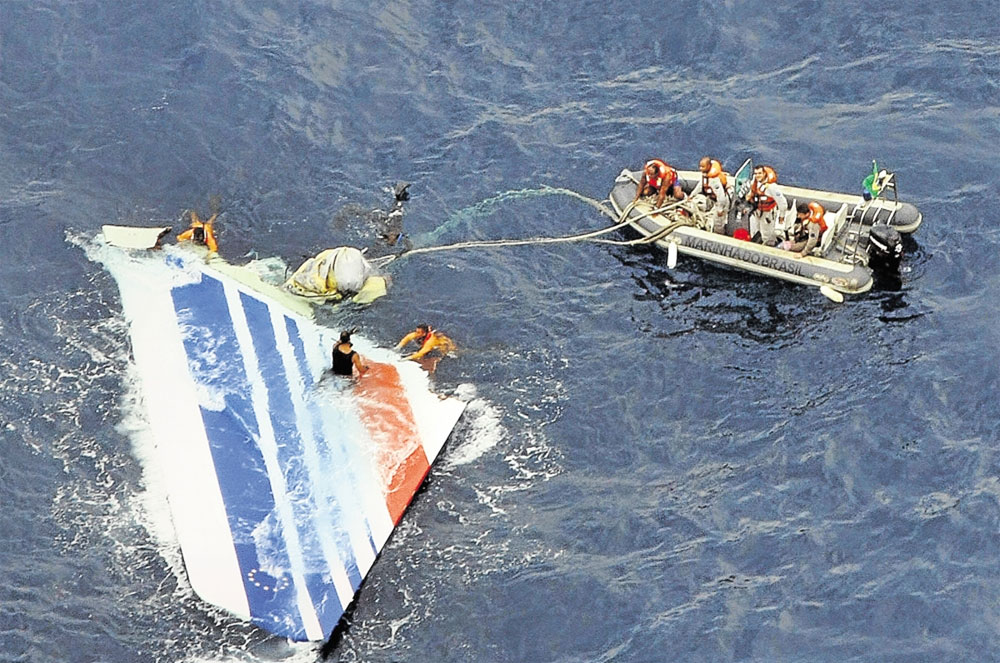
The Air France Airbus A330-200 went missing on transatlantic flight from Rio de Janeiro, Brazil, to Paris, France. The airplane carried 12 crew members and 216 passengers. The plane crashed in the Atlantic Ocean, killing all onboard. Flight AF447 departed Rio de Janeiro heading toward Paris. Three hours later, while the plane was flying over the Atlantic Ocean, the aircraft reportedly went through a thunderstorm with strong turbulence. A few minutes later, Air France received an automatic message from the A330 indicating electrical circuits malfunction. It was the last information received from AF447. Six minutes later, Brazilian Air Force said plane failed to make previously scheduled radio contact with Brazil. Last radio contact with the flight was at 01:33 UTC. The crew was in contact with the Atlantic Area Control Centre (CINDACTA III) when the flight reported over the INTOL waypoint, estimating TASIL at 02:20 UTC. INTOL is an RNAV waypoint located in the Atlantic Ocean, 565 km from Natal, Brazil. The TASIL waypoint is located 1228 kilometers from Natal. Over a time span of four minutes, starting at 02:10 UTC, a series of ACARS messages were sent -automatically- from the plane. Indication was that the autopilot had disengaged and the fly by wire system had changed to alternate law (mode allowing the flight control to work properly while some inputs parameters are not available or detected as erroneous). Between 02:11Z and 02:13Z a flurry of messages indicating failure of navigation and air data systems arrived. At 02:13Z flight control system faults were indicated, at 02:14Z the last message received was an advisory regarding cabin vertical speed. An analysis of meteorological information shows that AF447 crossed through three key thunderstorm clusters: a small one around 01:51 UTC, a new rapidly growing one at about 01:59 UTC, and finally a large multicell convective system (MCS) around 02:05-02:16 UTC.
View details
Location : Atlantic ocean
People on board : 228
Fatalities : 228
Air France Airbus A330 with 228 people onboard crashes in Atlantic ocean
The Air France Airbus A330-200 went missing on transatlantic flight from Rio de Janeiro, Brazil, to Paris, France. The airplane carried 12 crew members and 216 passengers. The plane crashed in…
China airlines Boeing 747 crash
Airline : China airlines
Aircraft : Boeing 747-209B
The aircraft was on a passenger flight from Taiwan's Chiang Kai Shek Airport to Hong Kong. The flight duration was expected to be 1h20. About 20 minutes after takeoff, while cruising at FL350, the aircraft disappeared from radar screens and crashed into the Taiwan Strait between Taiwan and China. Radar data suggests that the aircraft broke into four pieces while at FL350. This theory is supported by the fact that articles, which would have been found inside the aircraft (magazines, etc.) were found up to 80 miles (150 kilomètres) from the crash site. There was no sign of an explosion on the recovered debris, and no distress call was received from the flight crew. Weather around the time of the accident was clear. The final investigation report found that the accident was the result of "metal fatigue" due to inadequate maintenance after a previous incident. The report finds that on February 7, 1980, the accident aircraft suffered a tail strike occurrence in Hong Kong. The aircraft was then ferried back to Taiwan on the same day un-pressurized and a temporary repair was conducted the day after. A permanent repair was conducted on May 23 through 26, 1980. However, the permanent repair of the tail strike was not accomplished in accordance with the Boeing SRM (Structure Repair Manual), in that the area of damaged skin in Section 46 was not removed and the repair doubler did not extend sufficiently beyond the entire damaged area to restore the structural strength. Consequently, after repeating cycles of depressurization and pressurization during flights, the weakened hull started to crack gradually and finally broke open in flight on that flight, exactly 22 years after the faulty repair has been applied to the damaged tail. An explosive depressurization of the aircraft occurred once the crack was broken, causing the complete disintegration of the aircraft mid-air. All 225 passengers and crew members were killed.
View details
Location : off Penghu, Taiwan
People on board : 225
Fatalities : 225
China airlines Boeing 747 with 225 people onboard crashes in Taiwan
The aircraft was on a passenger flight from Taiwan's Chiang Kai Shek Airport to Hong Kong. The flight duration was expected to be 1h20. About 20 minutes after takeoff, while cruising at…
Metrojet Airbus A321 crash
Airline : Metrojet
Aircraft : Airbus A321-231
The Airbus A321-200 operated by Metrojet took off from Sharm el Sheikh, Egypt, for a passenger flight to St. Petersburg, Russia. 217 passengers and 7 crewmembers were onboard. 23 minutes after takeoff, while the plane was over the Sinai desert, it plummeted from the sky and crashed in Wadi Al-Zolomat, about 60 NM south of Al-Arish. All 224 occupants were killed. The plane departed the Red Sea resort of Sharm el-Sheikh, near the southern tip of the Sinai. It vanished from radar 23 minutes into the flight, while it was climbing through FL307 over the Sinai desert. There was no distress call from the crew. The wreckage has located in mountainous terrain straight below the last transmitted transponder position. The debris field expands 350 by 3200 meters (1150 by 10460 feet). Due to the large surface of the debris field, investigators believe that the aircraft broke up in midair. According to Egyptian Authorities, there is no evidence of hostile or missile activity around the flight path of the aircraft. The weather in the area was clear at the time of the accident. The director of Russia's Federal Security Service stated that he has studied the passengers’ personal belongings and luggage and fragments of the plane that crashed in Egypt. An expert examination of all these objects has found traces of foreign-made explosives. According to the experts, a self-made explosive device equivalent up to 1 kg of TNT was set off on board, which explains why the fragments of the aircraft were scattered over a large area. On November 17th 2015, the cause of the accident has been officially recognised as being a terrorist act.
View details
Location : Al-Arish, North Sinai, Egypt
People on board : 224
Fatalities : 224
Metrojet Airbus A321 with 224 people onboard crashes in North Sinai, Egypt
The Airbus A321-200 operated by Metrojet took off from Sharm el Sheikh, Egypt, for a passenger flight to St. Petersburg, Russia. 217 passengers and 7 crewmembers were onboard. 23 minutes after…
Lion Air Boeing 737 crash
Airline : Lion Air
Aircraft : Boeing 737-800MAX
The Boeing 737-800 MAX operated by Lion Air took off from Jakarta, Indonesia, for a passenger flight to Pangkal Pinang, Indonesia. 181 passengers and 8 crewmembers were onboard. The plane crashed 35 NM (65 kilometers) northeast of Jakarta over the Java Sea about 13 minutes after takeoff. All 189 people onboard were killed. The plane took off at dawn, at 06h21 local time. Shortly after takeoff, the flight crew radioed the controller, requesting a return to the airport. The airline reported the aircraft encountered a technical problem. Radar indications showed the plane climbing erratically, barely reaching 5,400 feet (around 1600 meters), before quickly dropping and disappearing from radar. The wreckage of the twin-engine, narrow-body plane was detected in the Java Sea. Water depth at the site is about 30-35 meters. Weather was fine with light winds, scattered clouds at 2000 feet and a visibility of 8000 m. The aircraft was almost brand new, having flown just 800 hours. The plane is a new model of the Boeing best-selling 737, which first debuted in 1967. Boeing introduced the 737 MAX family of aircraft in 2011, using quieter engines and more fuel efficiency than previous models as selling points. This accident is the first of its kind for this variant of the Boeing 737. On November 7th 2018 the FAA released an Emergency Airworthiness Directive (EAD) 2018-23-51 concerning all Boeing 737 Max aircraft. This EAD states that “This emergency AD was prompted by analysis performed by the manufacturer showing that if an erroneously high single angle of attack (AOA) sensor input is received by the flight control system, there is a potential for repeated nose-down trim commands of the horizontal stabilizer. This condition, if not addressed, could cause the flight crew to have difficulty controlling the airplane, and lead to excessive nose-down attitude, significant altitude loss, and possible impact with terrain.”
View details
Location : Off Jakarta, Indonesia
People on board : 189
Fatalities : 189
Lion Air Boeing 737 with 189 people onboard crashes in Indonesia
The Boeing 737-800 MAX operated by Lion Air took off from Jakarta, Indonesia, for a passenger flight to Pangkal Pinang, Indonesia. 181 passengers and 8 crewmembers were onboard. The plane…
Kenya Airways Airbus A310 crash
Airline : Kenya Airways
Aircraft : Airbus A310-304
The A310 was on a passenger flight, and departed from Abidjan. The aircraft crashed into the Atlantic Ocean shortly after takeoff from Abidjan. Numerous eyewitnesses who saw the airplane takeoff reported that it failed to gain altitude and struck the water around a mile from the runway. 10 survivors were pulled from the water by rescue boats. 169 people died. The Commission of Inquiry concluded that the cause of the accident to flight KQ 431 on 30 January 2000 was a collision with the sea that resulted from the pilot flying applying one part of the procedure, by pushing forward on the control column to stop the stick shaker, following the initiation of a stall warning on rotation, while the airplane was not in a true stall situation. In fact, the FCOM used by the airline states that whenever a stall warning is encountered at low altitude (stick shaker activation), it should be considered as an immediate threat to the maintenance of a safe flight path. It specifies that at the first sign of an imminent stall or at the time of a stick shaker activation, the following actions must be undertaken simultaneously: thrust levers in TOGA position, reduction of pitch attitude, wings level, check that speed brakes are retracted. The investigation showed that the pilot flying reduced the pitch attitude but did not apply TOGA thrust on the engines. The investigation was unable to determine if the crew performed the other two actions: leveling the wings and checking that the speed brakes were retracted. The following elements contributed to the accident: the pilot flying's action on the control column put the airplane into a descent without the crew realizing it, despite the radio altimeter callouts; the GPWS warnings that could have alerted the crew to an imminent contact with the sea were masked by the priority stall and overspeed warnings, in accordance with the rules on the prioritization of warnings; the conditions for a takeoff performed towards the sea and at night provided no external visual references that would have allowed the crew to be aware of the direct proximity of the sea.
View details
Location : Abidjan, Ivory Coast
People on board : 179
Fatalities : 169
Kenya Airways Airbus A310 with 179 people onboard crashes in Ivory Coast
The A310 was on a passenger flight, and departed from Abidjan. The aircraft crashed into the Atlantic Ocean shortly after takeoff from Abidjan. Numerous eyewitnesses who saw the airplane…
Caspian Airlines Tupolev 154M crash
Airline : Caspian Airlines
Aircraft : Tupolev TU-154M
The Caspian Airlines Tupolev 154M passenger plane was destroyed when it struck terrain near Qazvin, Iran, 16 minutes after takeoff. The airplane was en route from Tehran, Iran to Yerevan, Armenia. 153 passengers and 15 crewmembers were onboard. All 168 people aboard were killed. A few minutes after takeoff, the plane reached the altitude of 34000 feet (around 10000 m). The Tupolev 154 was in normal operation at that altitude. Three minutes before the crash, the plane suddenly turned 270 degrees and entered a rapid descent to 14000 feet (around 4200 m) in just 90 seconds. Air traffic controllers attempted to contact the flight, but there was no response. They asked two planes that were in the area to contact the doomed plane, but these attempts failed too. It crashed about 16 minutes after takeoff near the village of Jannat Abad outside the city of Qazvin, around 75 miles (120 km) northwest of Tehran. The airplane exploded on impact and disintegrated. The impact gouged a deep trench in the dirt field (a 10 meters deep crater), which was littered with smoking wreckage and body parts. Much of the wreckage was in small shreds. The plane suffered technical problem and was trying to find a place to land, when it crashed. Witnesses reported that the tail and at least one of the tail engines were on fire as the plane plummeted.
View details
Location : Qazvin, Iran
People on board : 168
Fatalities : 168
Caspian Airlines Tupolev 154M with 168 people onboard crashes in Iran
The Caspian Airlines Tupolev 154M passenger plane was destroyed when it struck terrain near Qazvin, Iran, 16 minutes after takeoff. The airplane was en route from Tehran, Iran to Yerevan,…
AirAsia Indonesia Airbus A320 crash
Airline : AirAsia Indonesia
Aircraft : Airbus A320-216
The AirAsia Indonesia Airbus A320-200 took off from Surabaya, Indonesia, for a passenger flight to Singapore, Singapore. 155 passengers and 7 crewmembers were onboard. The plane disappeared from radar screen while it was enroute at FL320 over the Java Sea. Debris and bodies have been recovered in the Java Sea. All 162 people onboard were killed. The aircraft experienced difficult weather conditions with storm cells while it was cruising over the java sea at FL320. The crew requested to deviate left of its airway and to climb to FL380. At that time, the aircraft was observed normally. Due to other traffic the aircraft could not get cleared to FL380 instantly and was cleared to FL340 at first. When the aircraft was radioed with the clearance to climb to FL340, there was no response anymore, but the aircraft was still visible on radar screens (the ADS-B was still emitting). 1 minute later, the aircraft disappeared from radar screen. The last recorded position was about 110 NM East-South-East of Pulau Belitung. There were seven aircraft passing through the area at that time at flight levels between 290 and 380, neither of them encountered any difficulties. Debris and bodies of the aircraft have been located two days later, on Dec 30th 2014, in the Java Sea about 110 NM from Pulau Belitung, about 5 NM (8 km) from the last radar position. Bigger debris of what appeared to be the aircraft wreckage have been located 40 Nm (70 km) from the last radar position. Both black boxes (CVR and DFDR) have been founded more than two weeks after the accident, on January 13th 2015. AirAsia Indonesia did not have a license to fly the Surabaya-to-Singapore route the day the accident occurred. The airline was approved to fly the route four days a week but it did not include Sunday. AirAsia Indonesia is a subsidiary of the Malaysian-based AirAsia group. The parent company owns almost 49% of the Indonesian operation.
View details
Location : Java Sea, Indonesia
People on board : 162
Fatalities : 162
AirAsia Indonesia Airbus A320 with 162 people onboard crashes in Indonesia
The AirAsia Indonesia Airbus A320-200 took off from Surabaya, Indonesia, for a passenger flight to Singapore, Singapore. 155 passengers and 7 crewmembers were onboard. The plane disappeared…
West Caribbean Airways MD-82 crash
Airline : West Caribbean Airways
Aircraft : MD-82
The aircraft was on a passenger flight from Panama City, Panama to Fort de France on the Caribbean Island of Martinique. The crew announced intentions to divert to Caracas. Then the aircraft began a rapid descent, and crashed into mountainous terrain some 20 miles from the Colombian border with Venezuela. According to the DFDR (Digital Flight Data Recorder) and CVR (Cockpit Voice recorder), the aircraft would have descended nose up. The crew was talking about weather conditions, and discussed possible icing conditions. The crew also thought about enabling wings and engines anti-ice devices. Analysis of the debris showed that both engines exhibited indications of high-speed compressor rotation at the time of impact, which enabled investigators to conclude that the engines were not previously damaged. The investigation shows that the cause of the crash is a combination of several human errors and bad weather conditions. The aircraft was overloaded by 6000 lb (about 2,5 tons), and weighted 155 000 lb at the beginning of cruise. Moreover, the weight was inadequately balanced. Therefore, the plane was more difficult to fly. Then, during cruise, the aircraft entered into a thunderstorm, with severe icing conditions. The engines iced, leading to a loss of thrust. Build-up of ice on wings may have also happened, which would have resulted in a decrease of the aircraft performance. The first officer immediately requested to engage the de-icing, but the captain did not take his request into account. Note that the first officer was inexperienced compare to the captain. Finally, the aircraft began to lose altitude. The crew then made a real mistake when they decided to switch off the auto-pilot. Indeed, the autopilot features a pitch correction function, which helps to fly the plane in this situation. Just after the auto-pilot disconnection, the MD82 stalled. It crashed 50 seconds later. Details about aircraft icing This kind of severe icing can occur when aircraft fly into particular weather conditions (for example, in a cloud of supercooled water droplets). Ice accretion on the wing leading edge may occur. Airflow disruption will reduce the maximum lift coefficient attainable by as much as 30% – 50%, thus raising the stalling speed considerably. And because the aircraft has to fly at a greater angle of attack to maintain lift, the induced drag also increases and the aircraft continues to lose airspeed, making it impossible to sustain altitude if the stall is to be avoided. The weight of the ice is also particularly constraining.Air data probes may also iced, which leads to misleading airspeed indications.Finally, the engine air intake may also be impacted by icing, leading to a loss of power and a possible engine overheating. An aircraft is usually designed to prevent and overcome the icing phenomenon. But in rare cases, the weather conditions are beyond the aircraft qualification conditions. In 1994, an ATR72 crashed near Chicago. Holding in ice for over an hour, the ice built up to the point that the aircraft became completely uncontrollable and spiralled to the ground.
View details
Location : Machiques, Venezuela
People on board : 160
Fatalities : 160
West Caribbean Airways MD-82 with 160 people onboard crashes in Venezuela
The aircraft was on a passenger flight from Panama City, Panama to Fort de France on the Caribbean Island of Martinique. The crew announced intentions to divert to Caracas. Then the aircraft…